Post Quantum Proofs of Reed-Solomon Codes with LeanAIR
Status: research writeup Code:
crates/lean-airImplementation:frisitano/leanMultisig@232308f2Author: Tau Lepton
TL;DR
LeanAIR evaluates a direct prover for a post-quantum Reed-Solomon data-availability commitment. On a 192-vCPU Graviton4 instance, the LeanAIR single-proof measurement is about 7.5 MiB/s, compared with the available single-proof lean-da measurements of 1.37 MiB/s for the LeanVM baseline parity check and 1.19 MiB/s for the LeanVM column-commit parity check. LeanAIR also reaches about 25 MiB/s aggregate proving throughput using parallel batching, but parallelized lean-da proof generation was not measured here. The prover is organized around the commitment-level operations:
- hash each fixed-size codeword cell;
- chain systematic cell digests into row commitments;
- Merkle-commit the cell columns;
- bind row and column roots into one public commitment;
- prove each row is a Reed-Solomon codeword using the barycentric parity identity.
The resulting proof uses a dedicated Poseidon table, WHIR openings of that table, and two families of virtual linear consistency claims. The row low-degree test is expressed as a sparse linear claim over the same committed trace columns that feed the cell hashes, so the values checked for Reed-Solomon validity are exactly the values committed by the cell and column commitments.
1. The Experiment
The earlier implementation used a LeanVM program:
- it witnesses row codewords;
- calls Poseidon precompiles for cell hashes and commitments;
- computes barycentric row checks inside VM execution;
- proves the whole VM trace.
In that implementation, the proof statement includes general VM execution components in addition to the commitment-specific computation:
- instruction decoding;
- bytecode accumulation;
- memory indirection;
- generic precompile request routing;
- repeated extension arithmetic through the VM execution model.
LeanAIR keeps the same proof backend family, field stack, Poseidon permutation, WHIR PCS, and Fiat-Shamir transcript shape, but removes the VM layer. The witness is lowered directly into a dedicated table whose rows are Poseidon16 compressions and whose columns are the Poseidon round witnesses.
The design represents the cryptographic and coding-theoretic work directly in the proof trace. Once the table layout is public, the proof can be organized around three ingredients: local Poseidon constraints, global linear wiring constraints, and a Reed-Solomon row check.
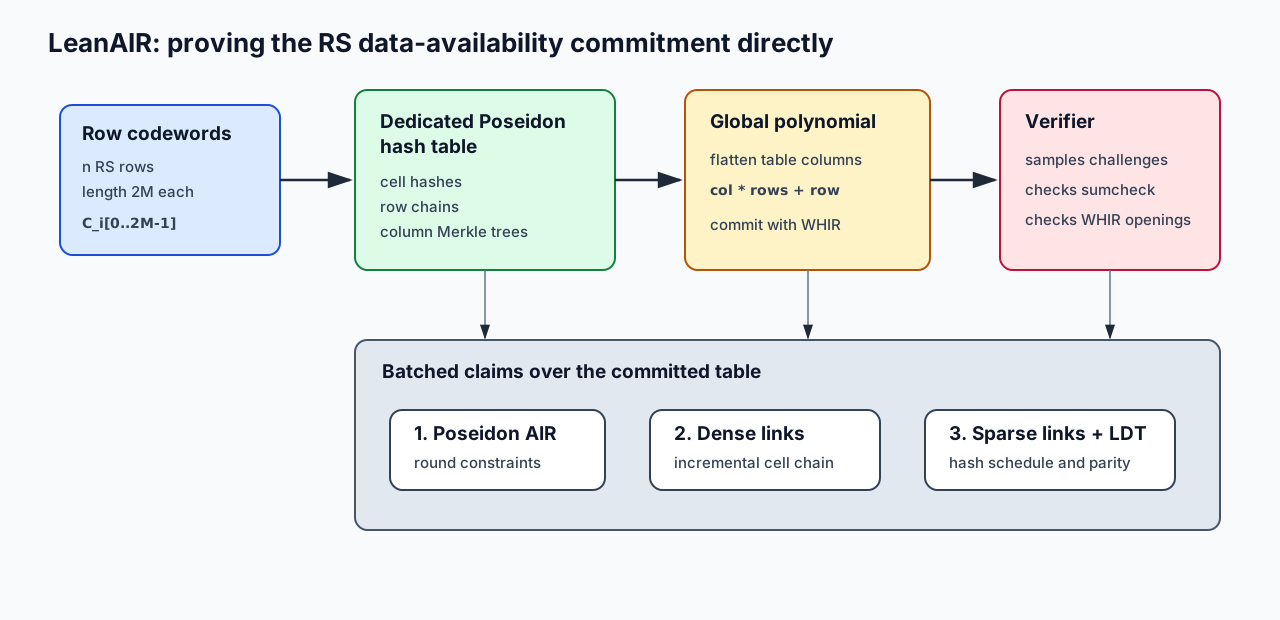
The current implementation is centered on:
crates/lean-air/src/hash_table.rs
crates/lean-air/src/proof.rs
The command-line benchmark entry point is:
crates/lean-air/src/main.rs
2. Commitment Shape
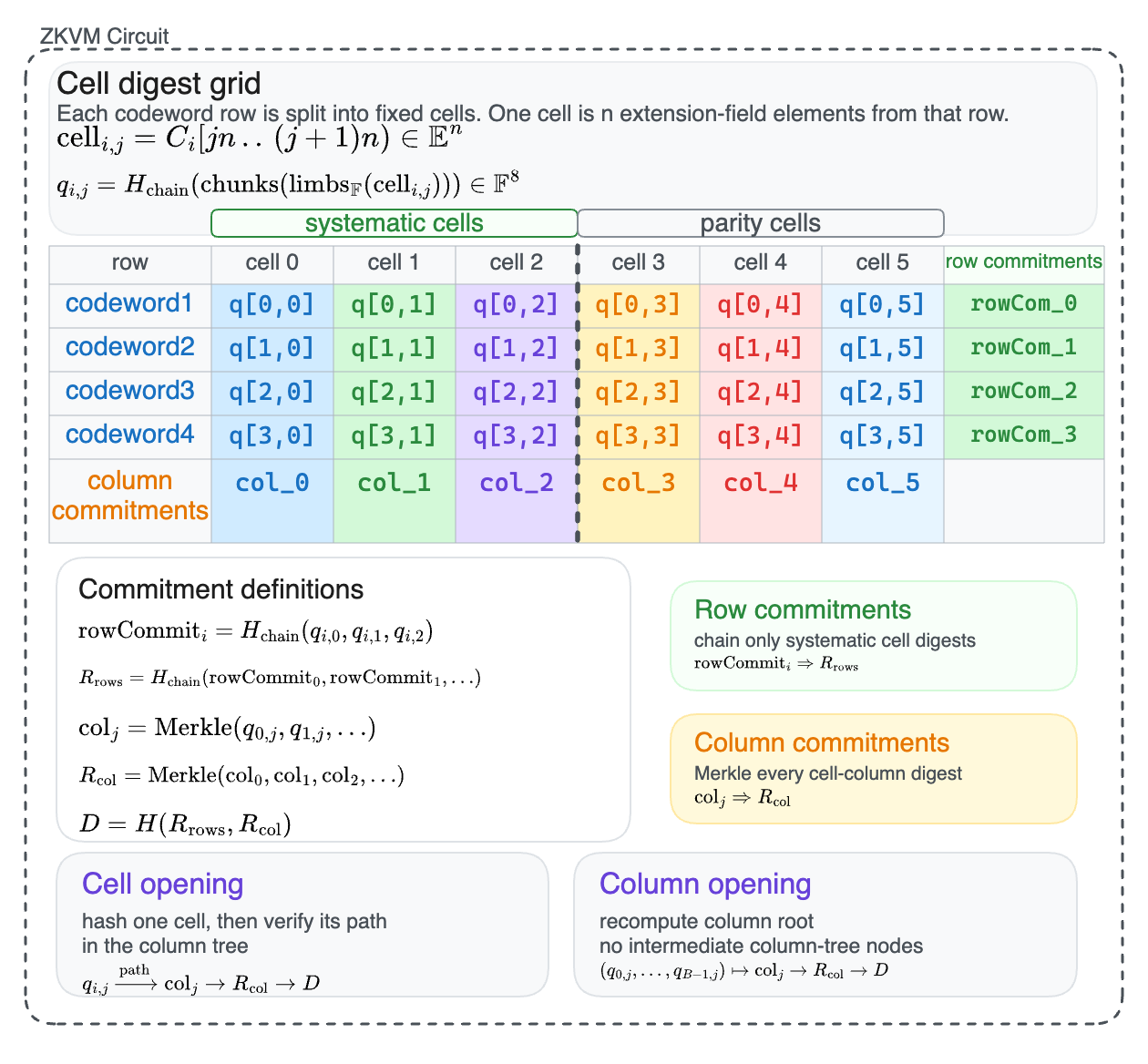
LeanAIR proves the commitment shape shown above. Each Reed-Solomon row is split into fixed cells, each cell is hashed into the digest grid entry q[i,j], and only the systematic cell digests feed the row commitments rowCommit_i -> R_rows.
Column commitments are built over every cell-digest column, giving col_j -> R_col. The public commitment is the final binding D = H(R_rows, R_col). A cell opening verifies one cell through its column-tree path, while a column opening recomputes the column root from the full opened digest column.
3. Trace, WHIR, and Virtual Claims
LeanAIR proves the diagrammed commitment by lowering every required hash into one deterministic Poseidon16 trace. The AIR constrains each hash row as a valid Poseidon compression, WHIR commits to the resulting trace columns, and sumcheck enforces the non-local wiring that connects cell digests into row commitments, column Merkle roots, the final commitment D, and the Reed-Solomon row check.
The public row schedule is fixed by the commitment shape:
| section | meaning | row count |
|---|---|---|
Cell | hash every row cell, including incremental chunks | n_rows * num_cells * chunks_per_cell |
SystematicRow | chain systematic cell digests into each row digest | n_rows * num_systematic_cells |
RowRoot | chain row digests into R_rows | n_rows |
ColumnMerkle | Merkle tree per cell column | num_cells * (padded_rows - 1) |
ColumnRoot | Merkle tree over column roots | num_cells - 1 |
FinalRoot | bind row and column roots into D | 1 |
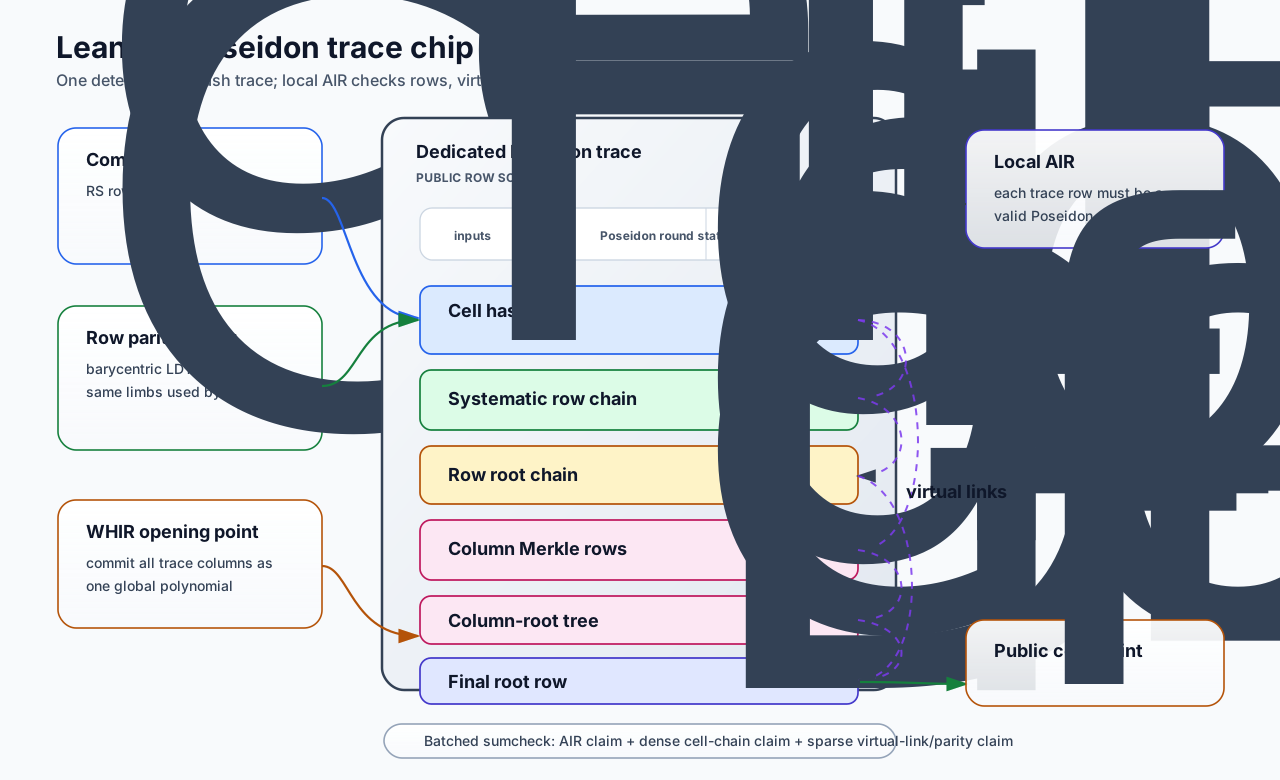
The committed table columns are flattened into one global multilinear polynomial:
global[column * padded_rows + row] = trace[column][row]
WHIR commits to this polynomial. The verifier samples a row-domain point, receives all column evaluations at that point, and checks one batched claim:
- local Poseidon AIR constraints;
- dense cell-chain links;
- sparse virtual linear constraints for schedule wiring and row parity.
claim = AIR_claim + eta * cell_link_claim + eta^2 * sparse_linear_claim
The dense links cover incremental cell hashes:
output(prev_chunk)[limb] = input(next_chunk)[limb]
The sparse links cover the public hash schedule:
- systematic row digests read cell hash outputs;
- row-root rows read row digest outputs;
- column Merkle parents read child digest outputs;
- the column-root tree reads column roots;
- the final root reads
R_rowsandR_col.
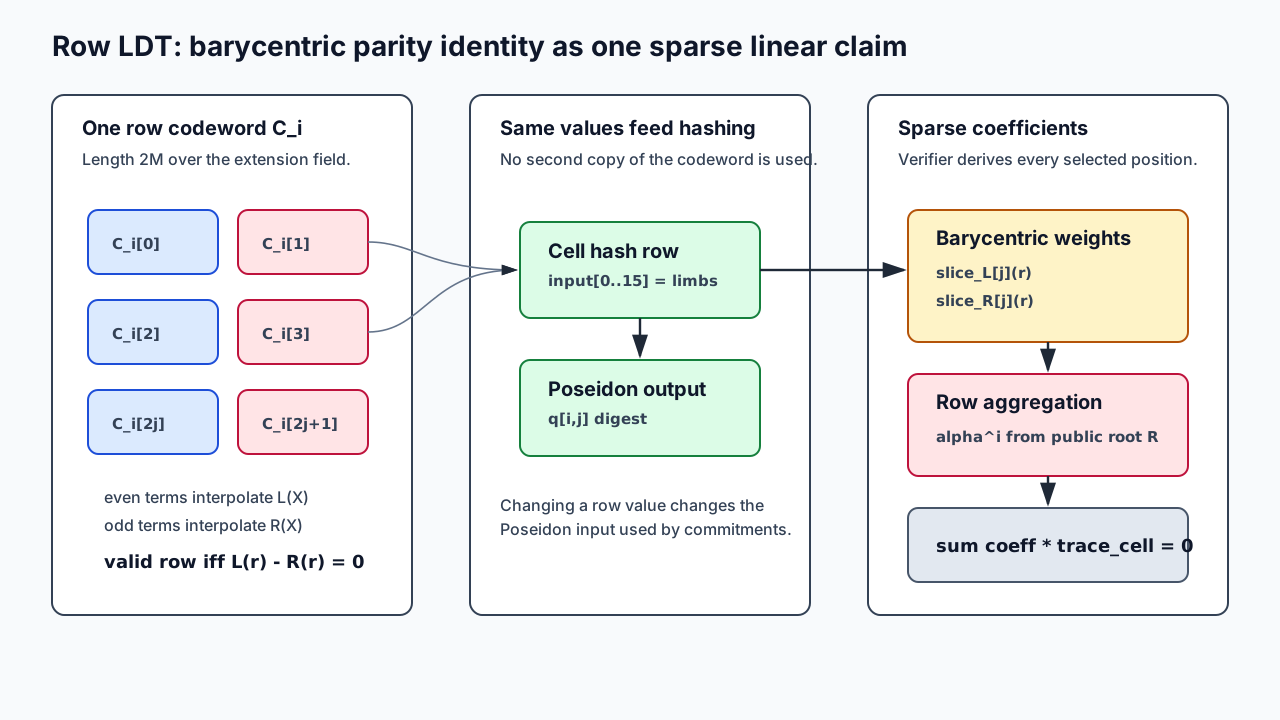
The row low-degree test is another sparse linear identity over the same committed columns. For each row codeword C_i, let w be a primitive 2M-th root of unity and u = w^2. The even and odd halves define:
L_i(X): interpolates {(u^j,       C_i[2j])}
R_i(X): interpolates {(w * u^j,   C_i[2j+1])}
A valid row satisfies L_i(X) = R_i(X). At a verifier challenge r, the barycentric form is:
sum_j slice_L[j](r) * C_i[2j] - sum_j slice_R[j](r) * C_i[2j+1] = 0
with:
slice_L[j](r) =  (r^M - 1) / (r * u^{-j} - 1)
slice_R[j](r) = -(r^M + 1) / (r * w^{-1} * u^{-j} - 1)
LeanAIR aggregates all rows using a challenge derived from the public commitment:
alpha = Poseidon16("LEANAIR row alpha" || log_m || n_rows || cell_len_ext || D)

sum_i alpha^i * (
    sum_j slice_L[j](r) * C_i[2j]
  - sum_j slice_R[j](r) * C_i[2j+1]
) = 0
The binding detail is that this parity identity does not read a separate codeword witness. The implementation maps each codeword limb:
C_i[t].limb_k
to the exact (trace_row, input_column) where that limb is absorbed by the Cell hash row. The parity check therefore reads the same values that are hashed into cell digests, then chained into row roots and column Merkle roots.
The sparse schedule and parity checks are combined as:
sparse_linear_claim =
    parity_claim + link_mix * hash_link_claim
This gives lookup-like binding without a generic logup or VM memory table. The schedule is public, so both prover and verifier derive the linear coefficients from public shape and transcript challenges. The values being checked are WHIR-committed trace columns.
This representation does not include:
- a separate lookup table;
- memory index columns;
- table-inclusion checks for every cell and digest edge.
This is a specialized representation for a fixed public schedule rather than a general lookup system.
4. Minimal Proving Machinery
The proof has three layers.
4.1 Poseidon permutation constraints
The LeanAirDedicatedHashAir table constrains each row to be a valid Poseidon16 compression:
input[16] -> Poseidon1-16 -> output[8]
It stores enough intermediate round state to keep constraints low degree:
- beginning full-round post-states;
- partial-round first-lane values;
- ending full-round post-states;
- final output limbs.
The partial-round block uses the backend low-degree AIR path:
low_degree_air() = Some((3, DEDICATED_HASH_PARTIAL_ROUNDS))
This keeps the partial-round constraints at degree 3 inside the AIR sumcheck.
4.2 Public root constraints
The final row of the Poseidon schedule must output the public commitment:
trace[output_limb][final_row] = D[limb]
These are passed to WHIR as SparseStatement::unique_value(...) constraints.
4.3 Virtual linear schedule constraints
The schedule constraints are not local AIR transitions. They are global linear identities over the committed columns:
source_digest_limb - sink_input_limb = 0
zero_padding_limb = 0
parity_weighted_codeword_limb_sum = 0
They are proved by the dense and sparse OuterSumcheckSessions and then tied back to WHIR openings at the sumcheck point.
The split is:
- Poseidon arithmetic is local and belongs in AIR;
- deterministic schedule wiring is global and represented as a virtual linear claim;
- row low-degree testing is naturally a global linear identity.
5. Benchmark Snapshot
The latest Graviton runs give the current performance shape.
| machine | vCPU | highest observed aggregate wall throughput | highest observed aggregate prove throughput |
|---|---|---|---|
| c8g.16xlarge | 64 | 12,774 KiB/s | 13,692 KiB/s |
| c8g.48xlarge | 192 | 25,117 KiB/s | 27,020 KiB/s |
At the matching 101 row/blob payload on the 48xlarge, the available measurements cover different execution modes:
| measured configuration | execution mode | throughput |
|---|---|---|
| LeanVM baseline parity check | single proof | 1,370 KiB/s |
| LeanVM column-commit parity check | single proof | 1,186 KiB/s |
| LeanAIR direct prover | single proof | ~7.5 MiB/s |
| LeanAIR highest-throughput batch | parallel batch | 25,117 KiB/s |
The LeanAIR aggregate result uses parallel batching across independent proofs. Parallelized lean-da proof generation was not measured here, so the table reports the observed configurations rather than an intrinsic speedup ratio between the two implementations. The LeanAIR single-proof value is recorded as approximate because the exact run artifact is not present in the local repo.
6. Commands
Single proof:
target/release/lean-air \
  --log-m 13 \
  --n-rows 101 \
  --cell-len-ext 512 \
  --prove \
  --runs 5 \
  --table
48xlarge batch shape used for highest wall throughput:
target/release/lean-air bench-parallel \
  --log-m 13 \
  --n-rows 101 \
  --cell-len-ext 128 \
  --concurrency 32 \
  --rayon-threads 6 \
  --runs-per-worker 3 \
  --pin
LeanVM parity-check comparisons:
target/release/lean-da --n-blobs 101 --construction baseline
target/release/lean-da --n-blobs 101 --construction column-commit